
Welcome to Week 7 of WordWise Wednesdays!
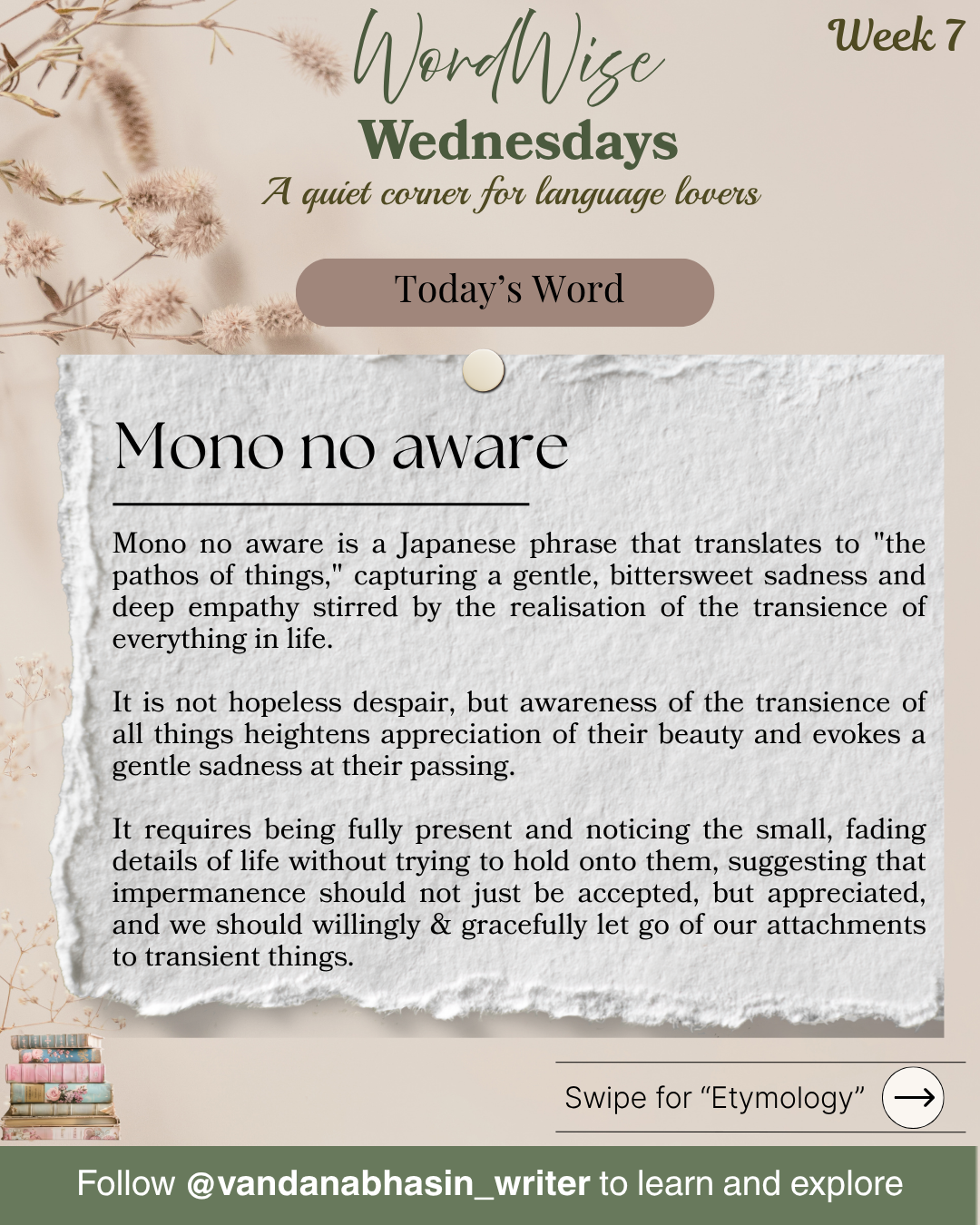
This week’s word is Mono no aware.
Mono no aware is a Japanese phrase that translates to “the pathos of things,” capturing a gentle, bittersweet sadness and deep empathy stirred by the realisation of the transience of everything in life.
It is not hopeless despair, but awareness of the transience of all things heightens appreciation of their beauty and evokes a gentle sadness at their passing.
It requires being fully present and noticing the small, fading details of life without trying to hold onto them, suggesting that impermanence should not just be accepted, but appreciated, and we should willingly & gracefully let go of our attachments to transient things.
Etymology:
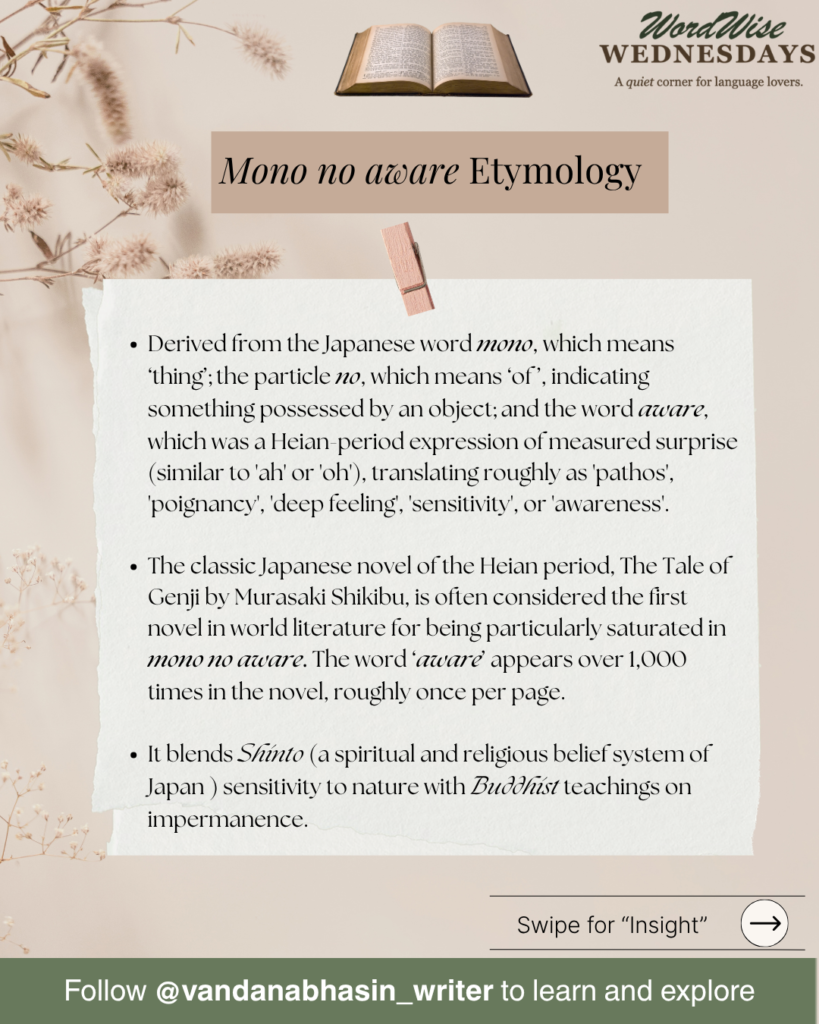
Derived from the Japanese word mono, which means ‘thing’; the particle no, which means ‘of ’, indicating something possessed by an object; and the word aware, which was a Heian-period expression of measured surprise (similar to ‘ah’ or ‘oh’), translating roughly as ‘pathos’, ‘poignancy’, ‘deep feeling’, ‘sensitivity’, or ‘awareness’.
The classic Japanese novel of the Heian period, The Tale of Genji by Murasaki Shikibu, is often considered the first novel in world literature for being particularly saturated in mono no aware. The word ‘aware’ appears over 1,000 times in the novel, roughly once per page.
It blends Shinto (a spiritual and religious belief system of Japan ) sensitivity to nature with Buddhist teachings on impermanence.
Insights:
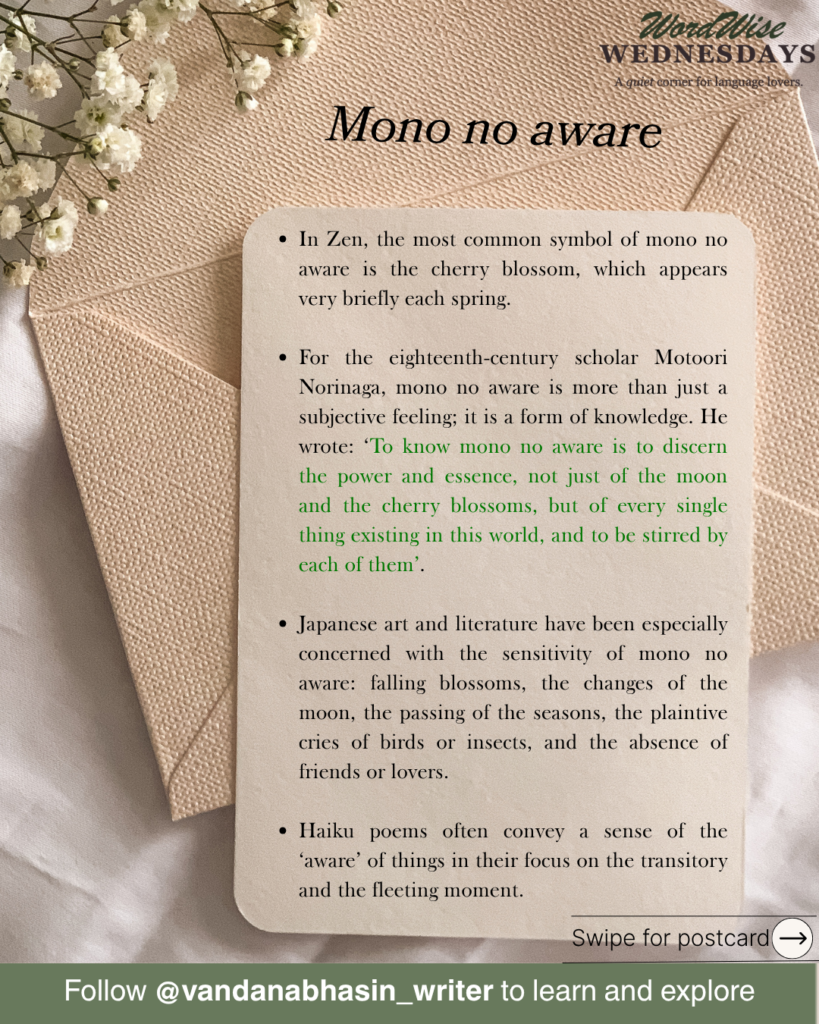
In Zen, the most common symbol of mono no aware is the cherry blossom, which appears very briefly each spring.
For the eighteenth-century scholar Motoori Norinaga, mono no aware is more than just a subjective feeling; it is a form of knowledge. He wrote: ‘To know mono no aware is to discern the power and essence, not just of the moon and the cherry blossoms, but of every single thing existing in this world, and to be stirred by each of them’.
Japanese art and literature have been especially concerned with the sensitivity of mono no aware: falling blossoms, the changes of the moon, the passing of the seasons, the plaintive cries of birds or insects, and the absence of friends or lovers.
Haiku poems often convey a sense of the ‘aware’ of things in their focus on the transitory and the fleeting moment.
0 Comments